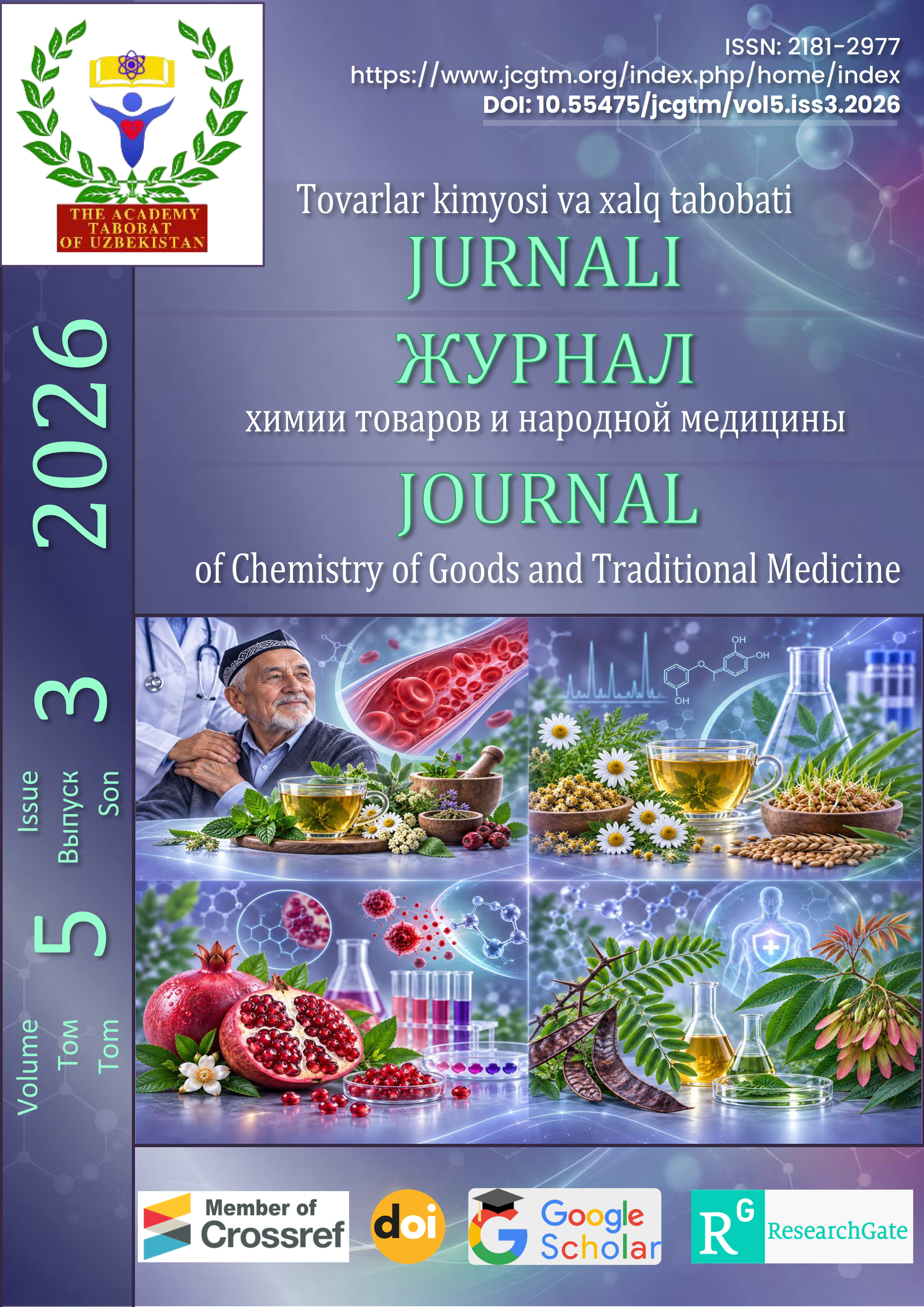
GLEDITSIA TRIACANTHOS L. VA AILANTHUS ALTISSIMA (MILL.) KOMPOZITSIYASINING FITOKIMYOVIY PROFILI VA BIOTIBBIY SALOHIYATI
DOI:
https://doi.org/10.55475/jcgtm/vol5.iss3.2026.670Kalit so'zlar:
saponins, quassinoids, ailanthone, flavonoids, phytocomposition, standartizationAnnotatsiya
Hozirgi vaqtda zamonaviy xalq tabobatida tabiiy xomashyo asosida xavfsiz, ko‘p maqsadli fitokompozitsiyalar yaratish, qator kasalliklar, jumladan, ginekologik kasalliklarning oldini olish va davolash dolzarb masalalardan biri hisoblanadi. Ushbu sharh maqolada har ikkala o‘simlikning tizimlashtirilgan tarkibi, ular asosida fitobirikmalar tayyorlash uchun texnologik va farmakologik afzalliklari hamda ularni biologik faol qo‘shimchalar ko‘rinishida keyinchalik qo‘llash imkoniyatlari yoritilgan.
References
1. Andonova, T., Petkova, Z., Teneva, O., Antova, G., Apostolova, E., Naimov, S., Mladenova, T., Slavov, I., & Dimitrova-Dyulgerova, I. (2024). Ailanthus altissima seed oil—A valuable source of lipid-soluble components with DNA protective and antiproliferative activities. Foods, 13(8), 1268. https://doi.org/10.3390/foods13081268 DOI: https://doi.org/10.3390/foods13081268
2. Belkhodja, H., Saidi, I., Mehali, S., & Zizi, F. (2019). Phytochemical screening and in vivo evaluation of anti-inflammatory potential of methanolic extract of Gleditsia triacanthos. Arab Gulf Journal of Scientific Research, 37(2), 1–11. https://doi.org/10.51758/AGJSR-02-2019-0007 DOI: https://doi.org/10.51758/AGJSR-02-2019-0007
3. Boukhibar, H., Laouani, A., Touzout, S. N., Alenazy, R., Alqasmi, M., Bokhari, Y., Saguem, K., Ben-Attia, M., El-Bok, S., & Merghni, A. (2023). Chemical composition of Ailanthus altissima (Mill.) Swingle methanolic leaf extracts and assessment of their antibacterial activity through oxidative stress induction. Antibiotics, 12(8), 1253. https://doi.org/10.3390/antibiotics12081253 DOI: https://doi.org/10.3390/antibiotics12081253
4. Caramelo, D., Pedro, S. I., Marques, H., Simão, A. Y., Rosado, T., Barroca, C., Gominho, J., Anjos, O., & Gallardo, E. (2021). Insights into the bioactivities and chemical analysis of Ailanthus altissima (Mill.) Swingle. Applied Sciences, 11(23), 11331. https://doi.org/10.3390/app112311331 DOI: https://doi.org/10.3390/app112311331
5. Cocîrlea, M. D., Simionescu, N., Petrovici, A. R., Silion, M., Biondi, B., Lastella, L., & Oancea, S. (2024). In vitro screening of ecotoxic and cytotoxic activities of Ailanthus altissima leaf extract against target and non-target plant and animal cells. International Journal of Molecular Sciences, 25(11), 5653. https://doi.org/10.3390/ijms25115653 DOI: https://doi.org/10.3390/ijms25115653
6. Kassem, I. A. A., El Awdan, S. A., & Saleh, D. O. (2021). Characterization of flavonoids and saponins from Gleditsia triacanthos by LC-ESI/MS/MS analysis: Pharmacological assessment of the anti-hyperglycemic and anti-ulcerogenic activities of G. triacanthos methanolic fruit extract and its n-butanol fraction. Pharmacognosy Journal, 13(3), 631–639. https://doi.org/10.5530/pj.2021.13.80 DOI: https://doi.org/10.5530/pj.2021.13.80
7. Li, X., Li, Y., Ma, S., Zhao, Q., Wu, J., Duan, L., Xie, Y., & Wang, S. (2021). Traditional uses, phytochemistry, and pharmacology of Ailanthus altissima (Mill.) Swingle bark: A comprehensive review. Journal of Ethnopharmacology, 275, 114121. https://doi.org/10.1016/j.jep.2021.114121 DOI: https://doi.org/10.1016/j.jep.2021.114121
8. Ma, S., Guo, X., Han, R., Meng, Q., Zhang, Y., Quan, W., Miao, S., Yang, Z., Shi, X., & Wang, S. (2024). Elucidation of the mechanism of action of ailanthone in the treatment of colorectal cancer: Integration of network pharmacology, bioinformatics analysis and experimental validation. Frontiers in Pharmacology, 15, 1355644. https://doi.org/10.3389/fphar.2024.1355644 DOI: https://doi.org/10.3389/fphar.2024.1355644
9. Makiej, A., Smułek, W., & Kaczorek, E. (2025). The perspectives of combining antibiotics with saponins—Herbal excipients. Molecules, 30(20), 4102. https://doi.org/10.3390/molecules30204102 DOI: https://doi.org/10.3390/molecules30204102
10. Mohammed, R. S., Abou Zeid, A. H., El Hawary, S. S., Sleem, A. A., & Ashour, W. E. (2014). Flavonoid constituents, cytotoxic and antioxidant activities of Gleditsia triacanthos L. leaves. Saudi Journal of Biological Sciences, 21(6), 547–553. https://doi.org/10.1016/j.sjbs.2014.02.002 DOI: https://doi.org/10.1016/j.sjbs.2014.02.002
11. Panasenko, O. I., Aksonova, I. I., Denysenko, O. M., Mozul, V. I., & Holovkin, V. V. (2020). Investigation of chemical composition of Ailanthus altissima (Mill.) Swingle. Current Issues in Pharmacy and Medicine: Science and Practice, 13(3). https://doi.org/10.14739/2409-2932.2020.3.216188 DOI: https://doi.org/10.14739/2409-2932.2020.3.216188
12. Rai, S., Acharya-Siwakoti, E., Kafle, A., Devkota, H. P., & Bhattarai, A. (2021). Plant-derived saponins: A review of their surfactant properties and applications. Sci, 3(4), 44. https://doi.org/10.3390/sci3040044 DOI: https://doi.org/10.3390/sci3040044
13. Saleh, D. O., Kassem, I., & Melek, F. R. (2016). Analgesic activity of Gleditsia triacanthos methanolic fruit extract and its saponin-containing fraction. Pharmaceutical Biology, 54(4), 576–580. https://doi.org/10.3109/13880209.2015.1064450 DOI: https://doi.org/10.3109/13880209.2015.1064450
14. Sharma, K., Kaur, R., Kumar, S., Saini, R. K., Sharma, S., Pawde, S. V., & Kumar, V. (2023). Saponins: A concise review on food related aspects, applications and health implications. Food Chemistry Advances, 2, 100191. https://doi.org/10.1016/j.focha.2023.100191 DOI: https://doi.org/10.1016/j.focha.2023.100191
15. Wang, R., Lu, Y., Li, H., Sun, L., Yang, N., Zhao, M., Zhang, M., & Shi, Q. (2018). Antitumor activity of the Ailanthus altissima bark phytochemical ailanthone against breast cancer MCF-7 cells. Oncology Letters, 15(4), 6022–6028. https://doi.org/10.3892/ol.2018.8039 DOI: https://doi.org/10.3892/ol.2018.8039
16. Wang, C.-M., Li, H.-F., Wang, X.-K., Li, W.-G., Su, Q., Xiao, X., Hao, T.-F., Chen, W., Zhang, Y.-W., Zhang, H.-Y., Wu, W., Hu, Z.-R., Zhao, G.-Y., Huo, M.-Y., He, Y.-L., & Zhang, C.-H. (2021). Ailanthus altissima-derived ailanthone enhances gastric cancer cell apoptosis by inducing the repression of base excision repair by downregulating p23 expression. International Journal of Biological Sciences, 17(11), 2811–2825. https://doi.org/10.7150/ijbs.60674 DOI: https://doi.org/10.7150/ijbs.60674
17. Asqarov, I. R., Qirg’izov, S. M., Mo’minov, M. M., & Turg’unova, D. SASSIQDARAXT (AILANTHUS ALTISSIMA) VA GLEDICHIYA (GLEDITSIA TRIACANTOS) O`SIMLIKLARI MEVASINING ANTIOKSIDANT FAOLLIGI. Tovarlar Kimyosi Va Xalq Tabobati Jurnali, 3(5). https://doi.org/10.55475/jcgtm/vol3.iss5.2024.382 DOI: https://doi.org/10.55475/jcgtm/vol3.iss5.2024.382
Downloads
Nashr etilgan
How to Cite
License
Copyright (c) 2026 Ibrohim Raxmonovich Askarov,Dilafruz Turgunova

This work is licensed under a Creative Commons Attribution 4.0 International License.
Mazkur jurnalda e'lon qilingan maqolalarning mualliflik huquqi, undagi ilmiy yangiliklar, tadqiqot natijalariga javobgarlik maqola mualliflariga tegishli hisoblanadi. Mazkur mualliflik huquqi "Creative Commons "Attribution" 4.0" xalqaro qoidaga asosan belgilanadi.